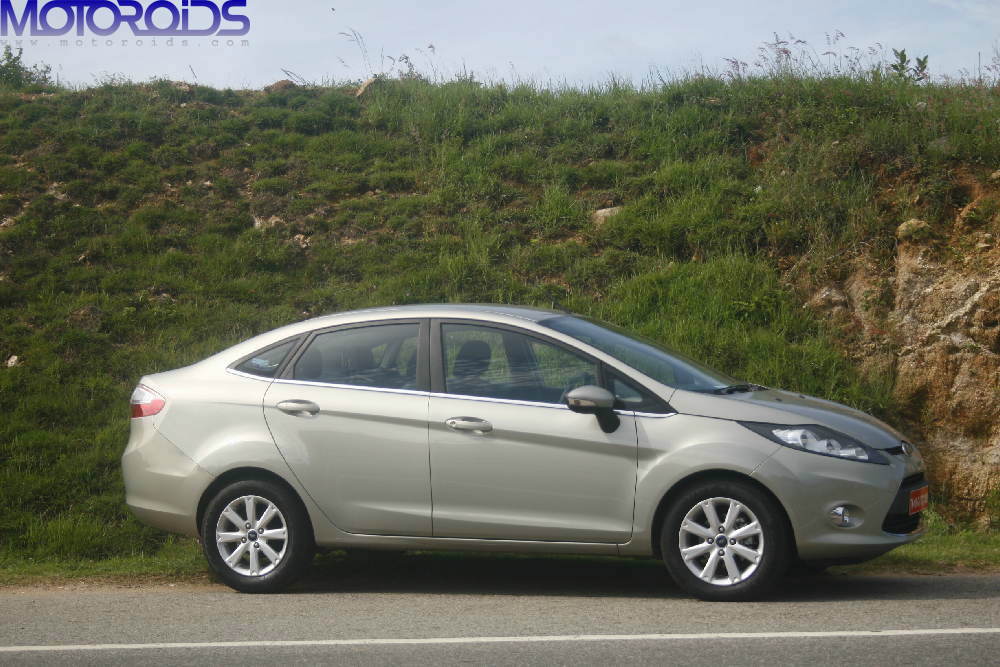
Ford India today officially launched their Fiesta Ti-VCT and TDCi sedans in India. The company has priced the car at Rs.8.23 lakh for the base petrol variant and Rs. 9.27 lakh for the base diesel variant
The car is available in four variants for both fuel types: Style, Trend, Titanium and Titanium Plus
The prices for the diesel variants ex-Delhi are as follows
Style 9.27 lakh
Trend 9.77 lakh
Titanium 10.17 lakh
Titanium Plus 10.42lakh
The prices for the petrol variants ex-Delhi are as follows
Style 8.23 lakh
Trend 8.77 lakh
Titanium 9.17 lakh
Titanium Plus 9.42lakh
*All prices are ex-showroom Delhi
Here is the detailed press release with all the information you need about the new Fiesta
Ford Launches All-New Global Fiesta in India
· Ford’s global All-New Fiesta premium sedan arrives here as first of the eight new global vehicles slated for launch in India by mid-decade
· The All-New Ford Fiesta is all set to engage and elevate customers with its eye-catching kinetic design, first-in-segment features and intuitive in-cabin technology for communication on the move
· Available in Style, Trend, Titanium and Titanium Plus trims with all new 1.5 L Ti-VCT (petrol) and 1.5 L Duratorq TDCi (diesel) engine options, with a choice of seven trendy colours
· All-New Fiesta premium trims start with the 1.5 L Ti-VCT Style at Rs. 823,500 (ex-showroom, Delhi) going up to the top-of-the-line 1.5 L TDCi ‘Titanium Plus’ at Rs. 10,42,200 (ex-showroom, Delhi)
· Ford India’s world class manufacturing facility near Chennai is the sixth plant to build the award-winning All-New Fiesta which has sold over a million units across five continents worldwide
DELHI, India, 14 July, 2011 – Ford India launched its global sedan, the All-New Fiesta, in the city today. The premium sedan, since its reveal earlier this year, has grabbed the attention of car buyers in India with its engaging and intuitive passenger communication technology. The globally evolved product brings to its segment a new meaning to passenger safety, delivers class-leading fuel efficiency and comes with first-in-segment smart features such as cruise control, electric power assisted steering (EPAS) and Advanced Bluetooth Voice Control.
Ford India today also introduced its first-ever 1.5-litre powertrains – 1.5 L Ti-VCT and 1.5 L Duratorq TDCi engines that will drive the premium sedan. The engines are designed and tuned to deliver an uncompromising razor-sharp performance, addictive drivability and best-in-class fuel efficiency. Both powertrains will be manufactured in Ford India’s state-of-the-art engine plant at Maraimalai Nagar.
The All-New Fiesta is available in four premium trims, across eight variants – Style, Trend, Titanium and Titanium Plus, with both petrol and diesel powertrain options in manual transmission. The 1.5 L Ti-VCT Style is priced at Rs. 823,500 (ex-showroom, Delhi) and the 1.5 L Duratorq TDCi Titanium Plus at Rs. 10,42,200 (ex-showroom, Delhi). Ford India is offering Anti-Lock Brake System (ABS), electronic brakeforce distribution (EBD), airbags and steering wheel audio controls as standard features among others, across all eight variants in both petrol and diesel options.
“We are excited to launch the All-New Fiesta to India and reiterate our One Ford vision by bringing you the first of the eight new global vehicles to be launched here by 2015. This premium sedan, with its many first-in-segment and innovative features, brings to its segment class-leading passenger safety, precision engineering and in-cabin technology and elevates the customer experience to a new level of engagement and connectivity while on the move,” said Michael Boneham, president and managing director of Ford India.
“Ford India is proud to be the sixth manufacturing location in the world to produce the All-New Fiesta,” he added.
Bold new exterior and interiors
At first sight, the kinetic design and bold and sexy exteriors of Fiesta appear international and flamboyant, aerodynamic and sporty – and make a style statement.
The All-New Fiesta’s seductive and aesthetic interiors reveal an advanced technological cockpit which is intuitive and impressively modern. The car comes equipped with exciting new features like an intuitive human-machine interface, first-in-segment Advanced Bluetooth Voice Control that allow for hands-free control over six functions such as phone, radio, CD, USB, iPod and electronic climate control.
The first-in-segment EPAS with Pull Drift Compensation technology adapts to changing road conditions leading to increased safety and control. Dual front air bags with ABS and EBD (standard across all variants) as well as an ultra-high strength body reinforced with aluminized boron steel in the All-New Fiesta make for an engaging and safe drive.
The All-New Fiesta is being launched in seven exciting colours – Diamond White, Moondust Silver, Sea Grey, Chill, Panther Black, Squeeze and Kinetic Blue.
An engaging drive, unmatched safety
Powered by all-new fuel-efficient 1.5 L Ti-VCT and 1.5 L Duratorq TDCi powertrains developed for India and built in Chennai, the new sedan delivers excellent handling in city as well as highway conditions, without sacrificing its essentially sporty character.
Both engines offer best-in-class fuel economy: 1.5 L Ti-VCT delivers 17 km/L and the 1.5 L Duratorq TDCi, 23.5 km/L1.
“Our extensive research revealed customers’ inclination and aspiration towards technology and we have the right product in the All-New Fiesta which addresses that requirement giving serious consideration to safety on the move. While adding dynamism and diversity to our showrooms across the country, this premium and engaging sedan brings in Ford’s global essence to the Indian market,” said Nigel Wark, executive director of Marketing, Sales and Service at Ford India.
Specially tuned front struts, bushings, damper stabiliser bars and a rear twist-beam axle provide sure-footed performance and comfort. The reinforced construction provides the necessary safety on the roads.
Fiesta’s ability to hug the road and cruise quietly is made possible by its rigid body structure, which Ford engineers have strengthened in many critical areas. More than 55 percent of the structure uses high-strength steel with ultra-strong boron steel reinforcing several key points.
The result is best-in-class occupant safety: passengers are better protected in the event of a side impact. Safety is also enhanced by standard front driver and passenger airbags on all models.
Lower cost of ownership and reliability
Ford India is offering a 2-year warranty/ 100,000 km to ensure the peace of mind that comes with owning the latest Ford. The years of research, superior materials and the best of engineering also bring to the customer a lower cost of ownership.
“With a comprehensive mix of technology, safety and comfort features, the dynamic new Fiesta packs in a peaceful and enduring ownership experience,” Wark added.
Ford India offers a hassle-free service and ownership experience with the All-New Fiesta through its 189 3S grade sales and service outlets in 107 Indian cities.
The all-new Fiesta at a glance


 Ford has been playing hide and seek with the journos about the launch dates of the new Ford Fiesta. The company gave us a preview of the car months ago, via the Fiesta cafe, but didn’t breathe a word about the launch dates. Then Ford India called us to Bangalore for a day long drive to Mysore and back, no word on the launch yet! Finally, after having seen and studied the response to the new Fluidic Verna to form a proper marketing strategy, the company seems to have decided to reveal the launch dates. The Fiesta is hitting the streets on the 14th of July.
 Since the car has not been launched, Ford India have not revealed the price. The Fiesta has some good features which no other cars in its segment have, such as Cruise Control. The voice activated controls too are a rare feature, with the Linea being the only other car in the segment to have a similar system. Our logic says that Ford India will launch the car at a price which is slightly lower than the Verna and the Vento. Nothing official, but that’s what we think, as Ford, with the Figo’s success now know how a right price tag can do wonders to the sales of a good product.
As stated earlier, we have driven the car, and put up a very detailed road test review of the website as well. You can follow this link to read the road test review of both 1.5 TiVCT and TDCi engines.
As always, bank on us to bring you a live launch coverage of the car.
What should be the correct pricing for the top end diesel variant of the car? Do let us know your views.

Most automakers would be gun-shy about following in GM's footsteps after witnessing the utter failure of the Astra, but for whatever reason, Ford felt it was prudent to bring their Fiesta subcompact to the United States, after a long and successful run in Europe, where cars the size of basketball shoes are a necessity due to high fuel prices and a lack of physical space.
For American consumers, a subcompact is a Scarlet Letter, denoting poor credit, limited financial means or a world-view more aligned with socialism than freedom. We really hope the Fiesta smashes these notions, since it?s one of the few cars that we can wholeheartedly say is worth your money.
AutoGuide has been fortunate enough to have prior access to the Fiesta, both on the first drive event in the Bay Area, and some seat time in the European market version back in 2009. On both occasions, we came away impressed with the car, but our week with the Fiesta was a chance to put it to the test in everyday situations outside of the gaze of Ford?s PR staff.
The Fiesta is undoubtedly in its element in urban environments, with its small footprint lending it well to squeezing into tight parking spaces, gaps in gridlocked traffic and quick U-Turns on busy arterial roads. Ken Block?s Gymkhana videos with his own Fiesta rally car may be a masterpiece of editing and trick camera angles, but the Fiesta really does feel that nimble, while exhibiting few of the typical subcompact foibles, like excessive engine noise (though a mechanical soundtrack is definitely present) or poor build quality. The car has a solid feel, without coming off as too hefty, while the steering properly communicates what the front tires are doing.
 |
With only 120 horsepower from its 1.6L 4-cylinder, the Fiesta is what some politely call a momentum car? meaning that you must keep the accelerator pinned at all times, lest you lose any of the precious speed you?ve already built up. Our test car, a mid-level SE model, was equipped with Ford's new PowerShift Automatic transmission, which is actually a dual-clutch style gearbox similar to (but not exactly like) Volkswagen?s DSG system. What separates the two gearboxes is Ford?s attempt at making the PowerShift as close to an automatic as possible. While there?s no paddle option for sport-oriented drivers, the PowerShift really is the best of both worlds, with all the smoothness of an automatic, while retaining the fuel economy advantages associated with a manual transmission (Ford estimates 30 mpg in the city and 40 mpg highway). We did notice that the Fiesta took a second or two to creep away from stoplights, as a real manual would, but most buyers won't pick up on that sort of thing.
Spending time in the interior is the biggest indicator of Fords intentions with the Fiesta, specifically its attempt to position the car as a more upscale alternative for younger buyers. The dashboard, steering wheel and other surfaces are finished in plastics that are much better than most compacts, and the design of the buttons, steering wheel and other tactile surfaces looks like they actually had a fair amount of effort in them. Stereo controls are large and clearly labeled, while the lock button for the doors is centrally mounted on stack. These may seem like minor details, but they?re a nice ergonomic touch that will go a long way towards endearing potential customers. Equipment, even on the SE, is generous, with the aforementioned power locks, windows, mirrors, as well as Fords SYNC system with Bluetooth capability, SIRUS satellite radio, an iPod connector and air-conditioning.
 |
Five basketball players may not find the Fiesta too spacious, but for normal adults, short trips across town will be bearable. Likewise with respect to cargo, a flat screen TV may require the rear seats to be folded down, but a week?s worth of groceries for two will fit in the small but livable rear compartment. Unfortunately, Ford had to cut corners somewhere, and we were less than impressed with some of the materials, like the headliner and the seat fabric, which is a somewhat coarse cloth that feels like canvas to the touch.
On the road, the Fiesta feels light on its feet, with well-weighted steering and a well-tuned suspension making the car a wonderful commuter. Rather than the buzzy, tin-box feel of other subcompacts, the Fiesta allows the driver to zip in and out of gaps in traffic. Large potholes and frost heaves are soaked up well, and after a few minutes of darting in and out of traffic, you begin to question why anything bigger than a Fiesta is necessary for the daily grind.
 |
On the highway, things get a little dicer, as road, wind and engine noise become more apparent, and the lack of power makes passing other cars a challenge. Fortunately, the brakes hold up well in both arenas, and we liked the progressive yet strong nature of the brakes when we were unfortunately had to test them out to their fullest potential.
Our test car, equipped with the Rapid Spec 201A (which is required to get Sirius Radio on the SE model) cost $17,985 when all is said and done ? a fairly hefty amount for a subcompact hatchback. We can understand why some buyers would shy away from laying out this kind of coin for a Fiesta, but the car really is more than the sum of its parts, offering a premium compact suite of features in a subcompact wrapper that looks a whole lot better than the rest of the competition. For those who do a lot of urban driving and aspire to more than a Yaris, we can wholeheartedly recommend the Fiesta as a solid choice in this segment.
 New Ford Fiesta road test / review
 The new Fiesta, as all of you would reckon has a humongous task at hand. The Fiesta Classic or the previous generation Fiesta used to be the gold standard in handling and driving dynamics for cars this side of Rs. 10 lakh. Does the new car have the goods to take forward the sporty legacy of its predecessor? Also, with the competition heating up in the C segment with new entrants like the Vento and Verna, does the new Fiesta has the stuff to make a mark for itself? We took the car for a drive around Bangalore for a day, and tried to unravel the virtues, wonders and vices of this smart looking new car from Ford stable. Here’s what we experienced
New Ford Fiesta – Genesis

A team of designers, engineers and vehicle dynamics specialists was deputed to get the Fiesta altered for the Indian conditions, and after more than two years of research, development and testing, and India specific version of the car was ready.
Design and styling
The new Fiesta comes across as a dynamic, sporty and ready-for-action car on the first look, especially from the front. The sharply styled headlamps make no bones about the athletic overtures of this car. The three multi focal barrels housed within the external elongated and swept back assembly go a long way in underlining the dynamic character of this car. The huge central air-dam, generously flared wheel arches and chiselled flanks of the bonnet further augment the feeling of athleticism.
The front forward, toned, muscular theme is carried forward in profile as well. There is an extremely pronounced crease running across the waistline of the car, emanating from the front wheel arches and merging into the rear fender. The waist line crease is accompanied by a parallel running line on the lower portion of the doors. Together the two lines create what would be an automotive equivalent of a horse’s tendons. Unlike a few other cars in its segment, this one is not out here to exude elegance or subtlety. It’s bred for a dash, and that’s what its exteriors convey – at least from the front and the sides.
However, the design seems to lose its way slightly as you approach the rear. The wraparound roundish tail-lamps don’t quite talk the same language as the sharply styled, elongated front headlamps. When looked at from the rear three quarters, the Fiesta looks relatively bulky. There are some elements which try to lend some muscle to the rear such as the extended lip on the top of the boot and the chiselled bumpers, but the effect isn’t quite as dynamic as the front. More horizontally positioned and sharply styled tail-lamps matching the headlamps in would have helped.
Engine and gearbox

The new Fiesta is offered with two engine options – a 1.5-liter TiVCT petrol with variable valve timing, and a 1.5-liter TDCi turbo diesel with intercooler. As goes with most modern similar capacity petrol-diesel engine variants on most new car models, the diesel mill is the pick of the two. Both engines are mated with a five-speed manual transmission, more on which later.
The 1.5-liter TDCi engine, as some of you would have assumed by now, is a development over the 1.4-liter TDCi unit which powers the Fiesta Classic and once used to propel the Ikon as well. In its latest version, the powerplant not only gets to displace more cubic centimetres, but also gets an intercooler. Peak power and torque outputs from the newly developed engine are rated at 91 BHP @ 3750 rpm and 204 NM @ 2000 – 2750 rpm respectively. The highlight of the engine is its smooth power and torque delivery, along with class leading fuel efficiency. ARAI has rated the new Fiesta’s 1.5-liter diesel mill with a fuel efficiency figure of 23.5 kmpl.
Driveability was always one of the older generation diesel Fiesta’s best known virtues. Thankfully, the new Fiesta is no different. The power delivery is progressive, and bucketloads of torque is available from lower down the rev range. Although the engine comes into its element only after you have taken it past the 1800-2000 rpm, the build-up begins way before the mark. The pull from the 1.5-liter mill is sufficient to keep you rolling without any splutter from as low as 1200-1300 rpm onwards in city traffic. Talking of the stop start city traffic, we found the clutch of the diesel Fiesta on the heavier side. On driving in bumper to bumper traffic situations, operating the clutch pedal over a long period turns out to be a fatiguing affair, as we realised on our way out from the congested Bangalore streets.

Once on the highway, and given a chance to extend its legs, the diesel Fiesta is a much better car to drive. In-gear acceleration is great, the response from the engine is quick and overtaking happens without having to play around much with the clutch or the gearstick. Redlined at 4500 rpm and marked all the way up to 6000rpm, the engine remains responsive and shows keenness to move forward over a wide range of revs. The Fiesta diesel is no scorcher, but with its linear power delivery, great driveability, and reasonable punch, it should be able to delight a discerning enthusiastic driver when needed.
Gearshift quality is good, but we have experienced better, more precise shifts on Ford cars. I am not complaining, but I really have experienced better shift quality on Ford cars in the past. There is a certain degree of notchiness to the shifts and you can feel the gates if you are slightly rough with the shift action.
All in all, the new 1.5-liter engine impresses as a practical, fuel efficient and driveable unit, which can deliver some excitement too, when required.
The surging price of petrol has forced carmakers shift their focus from outright performance to good driveability and optimum fuel efficiency. The Fiesta’s 1.5-liter Ti-VCT petrol engine too is tuned more towards being worldly wise than exuding flamboyance. While the driveability factor of the new engine did impress us, it isn’t quite a hooligan. The power and torque output figures from the new engine are 110 Nm @ 6045 rpm and 140 Nm @ 4500 rpm. While the 0-100 sprint time for the petrol variant (at around 11s against the diesel variant’s 14) is quicker than its diesel counterpart, in the real driving conditions, the diesel feels more potent and eager to thrust forward. There is a throaty tone to the exhaust which sounds sporty and gets even more sonorous when the engine sound joins in after 4000 rpm. However, the petrol version of the car doesn’t quite go as well as it sounds. It’s smooth, responsive and very linear in terms of the power delivery though. To best it all, just like its diesel counterpart, the petrol variant too delivers astounding fuel efficiency, rated at 17kmpl by ARAI. The clutch on the petrol variant is lighter than the diesel variant, making shifts less of a hassle in stop start traffic conditions.
Cabin quality, space and comfort

We can state in no equivocal terms that the Fiesta boasts of the sportiest driver and front passenger seat on any car in, or below its segment. Extremely well bolstered, the front seats hold you tight and provide superior lateral support along with great back and thigh support. There is a problem though. If you are more than hundred kgs and have a fat behind, it’s going to spill over the bolstering, and you won’t be very comfortable. Basically you need to be in reasonable shape to enjoy the sporty and comfortable front seats of the new Fiesta to the fullest.
The space at the backseats isn’t best in class. Headroom and knee-room is just about sufficient and those who like spending their time on the back bench won’t be too pleased. There is a central armrest with cup holders on the top end variant though. Ford India’s top management, during an interaction with Motoroids during the unveiling of the Fiesta in Delhi clarified that the company’s isn’t exactly focusing on the family guy with this one. The focus in on the enthusiast who likes driving himself, with the family coming into picture only once in a while. New Fiesta, like its predecessor has driving dynamics, handling, and steering feedback as its biggest virtues, and while back seat space is reasonable, it’s not impressive by any measure.
Ford India has worked extensively on making sure that the in-cabin noise is reduced to a bare minimum. NVH levels in the Fiesta, as represented by Ford India via a presentation to the journalists are substantially lower than its rivals. We’ll have to agree with their claims as the noise insulation within the cabin was actually impressive. There is hardly any wind and road noise filtering into the cabin, making the interior of the Fiesta quite a tranquil space on smooth surfaces.
There aren’t many storage spaces within the Fiesta’s cabin though. Apart from a recess ahead of the gear shifter and bottle holder behind it, there aren’t any other cubby holes for the front passenger to store knick-knacks. The doors have map pockets, and there is a small glove box too, but that’s about it. If you are used to having many storage spaces in your car’s cabin to pop stuff into, you won’t be too happy.
The quality of the material used on the dashboard is absolutely top notch. The same, however, cannot be said about the quality of the plastics on the door panels. For a car in this segment, the expectations of the customer are soaring high with every passing day. With new entrants like the Verna having raised the bar quite a bit in terms of quality and finish of the materials, the plastic quality on the new Fiesta’s door panels, and a few other parts doesn’t excite us too much. The centre console has been designed well, and is quite intuitive to use too with reasonably sized buttons expressing their functions very clearly. The contoured steering wheel is nice to hold, though a bit more chunkiness would have felt better for this kind of a sporty car. The red coloured display on the centre console and the instrument cluster delivers information in a very readable and functional way, but somewhat lacks in terms of modernity and jazz factor. Car information displays have gotten better over a period of time, and even small cars these days are offering cooler looking displays. While full marks go to Ford for the functional aspect of the switchgear and display, we really think it could have done with looking a bit more contemporary and cool. Chevrolet Beat’s display can be a good example to demonstrate what the modern versions of such displays look like.
Features and details

The Fiesta is quite a feature rich car and introduces a few firsts in its segment, with Cruise Control being the most prominent amenity in the list. Voice activated A/C, stereo and phone controls may not be an absolute first in the segment, but come across as a great and rare feature nonetheless. You can select tracks from your CD/USB, make calls, increase or decrease cabin temperature and do a lot of other stuff with the voice activated controls. We tried the voice activated controls on our way to Mysore and back, with around 70% success rate. The system works well most of the times, except sometimes when it either doesn’t understand your command or takes it as some other command. USB and Aux-in feature, with sockets placed behind the gear shifter, is integrated in the music system which sounds reasonably well at low to medium volume, but tends to lose quality as you turn the volume towards full blast.
Stereo controls are located on the left hand side of the steering wheels, while the Cruise Control buttons rest on the right hand side. You can increase or decrease cruising speed, cancel it when not needed, and resume it once you find an open stretch ahead. The voice controls gets activated once you press the ‘speak’ button placed behind the steering wheel on the lights stalk. The tip of the very same lever acts as the toggle button various displays on the instrument cluster, switching between average speed, average consumption, instantaneous consumption, distance to dry and a sea of other useful information. Interestingly, the wiper and headlight control stalks are on the ‘wrong’ side from the Indian point of view, as they have been lifted straight from the international variant.
ABS and twin front airbags are features that we expect on a car in this segment, and Ford India duly obliges. There is another feature christened Pull Drift Compensation by Ford, and introduced in the new Fiesta. What it does is, calculate the steering inputs on a constant basis while you are on the move, especially on the highway, and adjusts steering inputs required to compensate for unwanted disturbances such as undulations on the road and crosswinds. It tried to feel it working, but didn’t quite manage to.
Automatic climate control, auto retracting electric mirrors, electric ORVMs, driver side auto up and down window, child lock, remote locking for doors from the front and rear parking sensors are a few other features that need a mention.
In terms of looks and aesthetics, the interior of the Fiesta makes for a nice place to be in. The instrument binnacle, along with the contoured height adjustable steering wheel makes for a sporty look. A/C vents at the edge of the dashboard adopt the trusted round design. The vents flanking the center console look good with their vertical trapezoidal shape.
Overall, the Fiesta comes across as a reasonably feature packed car which scores highly in terms of functionality but lags a bit when compared with its rivals in terms of the premium feel, backseat space and lavishness within the cabin.
Ride quality, handling and driving dynamics

Good driving dynamics form an essential part of any Ford vehicle’s DNA. The Fiesta is known to be an excellent handler, but the ride quality on the European version is slightly on the firmer side. For the Indian version, Ford engineers have managed to make the ride softer by increasing the tyre profile and tweaking the suspension a little bit. The exercise has also raised the ground clearance by 15mm to make the new Fiesta even more suitable for the Indian roads.
The Indian Fiesta offers a ride quality which is slightly on the firm side, even with the higher profile tyres. However, there are no issues with ride comfort as the suspension is adequately absorbent and well damped. The real virtues of the set-up come to the fore when you push the Fiesta to its limits, especially around corners. Unfortunately the drive from Bangalore to Mysore via NICE road didn’t comprise of many twisties, so we weren’t really able to appraise the handling prowess of the new Fiesta completely. It was a shame, really, as handling and driving pleasure are supposed to be THE biggest virtues of the new Fiesta, and we would really have loved to take the car to its limit on that parameter. We did, however manage to do some handling tests with some high speed double lane change manoeuvres and pushing it hard around some long sweepers. And the Fiesta did deliver the goods. The car responded to directional inputs at speed without any drama. Body roll is minimal and you don’t need to dial in additional steering inputs to compensate for weight transfer after a hard steering manoeuvre at speed.
There is plenty of feedback from the steering wheels, which keeps getting progressively heavier with speed. The Fiesta feels like a solid, sure-footed and planted car at high speeds, with the steering getting lighter to aid manoeuvrability at low speeds within the city.
Overall
The Fiesta continues to stay true to its legacy in its newest avatar – at least in the handling department. The diesel engine is a good combination of power and driveability and is definitely the pick of the two powertrains. We think the petrol engine could have done with a bit more poke.
Ford is making no bones about the fact that the new Fiesta is a driver’s car. They are trying to target the family guy with this one, and that’s one reason why we didn’t mind the lack of backseat space much. The company is targeting a niche, and with its great handling, sporty styling and driver centric features, the Fiesta manages to hit the bull’s eye.
Loaded with great features, the Fiesta is an amazing car if you love driving yourself. For most such people, things like the quality of fabric, or feel of the plastics doesn’t matter much. And if you are one of them, you’re going to have a lot of fun in this new baby from Ford.